Dr.
Orren Strong Sanders 1820-1898
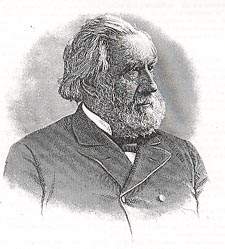 Orren
Strong Sanders, M.D., Boston Mass.,
was born in Epsom, Merrimack County,
N. H., September 24, 1820. He is the
eldest son of Colonel Job and Pollie
Sanders, being the senior of four
sons. The palms of his hands were
hardened before he reached his teens
in handling the implements of an industrious
farmer.
Orren
Strong Sanders, M.D., Boston Mass.,
was born in Epsom, Merrimack County,
N. H., September 24, 1820. He is the
eldest son of Colonel Job and Pollie
Sanders, being the senior of four
sons. The palms of his hands were
hardened before he reached his teens
in handling the implements of an industrious
farmer.
At the age of thirteen years and a
half he went to live with General
Joseph Low, Concord, N. H., for one
year as a servant, receiving for his
services two months' schooling and
fifty dollars, the whole of which
sum, with the exception of five dollars,
he gave to his father.
The succeeding year he served seven
months as a farm-hand with Judge Whittemore,
Pembroke, N. H., for nine dollars
a month, rising early and working
late. During the following winter
he attended the town school in his
father's district.
In April, when fifteen years and a
half old, he went to Northwood, N.
H., to learn the trade of a carpenter
with the late Luther and William Tasker,
receiving fifty dollars and three
months' schooling that year.
In March, 1836, as soon as the district
school closed in Epsom, he decided
to change his purpose in life, and,
with his neighbor and friend, Henry
F. Sanborn, went on foot, with a bundle
of clothes, a few books in hand and
seventeen dollars in his pocket, seventeen
miles to Gilmanton, N. H., where he
commenced in earnest to obtain, in
the middle of the spring term, an
education. In the summer term he again
went to Gilmanton, boarding himself,
with three other students, for ninety
cents each a week.
In the autumn of the same year, a
younger brother desiring to attend
school, he changed his plan, and went
to Pembroke, N. H., it being less
than half the distance to "Old
Gilmanton," and there he continued
his studies for several successive
terms, practicing the economical method
of "playing house-keeping."
Shortly after he had attained his
sixteenth birthday he commenced his
first school in Chichester, N. H.,
known as the Meeting-House, or Reed
District, for the sum of eight dollars
a month and "boarded round."
This school had about thirty scholars
enrolled, and the sixteen dollars
appropriated to the object of education
for the winter months secured for
them the benefit of young Sanders'
earnest efforts to stimulate them
to increased mental activity, to make
up for brevity of opportunity.
The following winter this persevering
youth was reengaged to instruct in
the same district, and at the termination
of this school term he commenced teaching
the school in Bear Hill District,
and at the end of twelve weeks closed
his efforts with a brilliant exhibition.
In the following autumn he spent fourteen
weeks in Northwood, teaching in the
lower part of the town; following
this school, he served as teacher
in the "Young District,"
in Barrington, returning to Northwood
the succeeding winter, and gave another
term of services in the same locality
as before.
His last and final experience as "school-master"
was in the Cilley District, in his
native town, where he was favored
with a large attendance and secured
a successful result.
Six months after he had passed his
nineteenth birthday he commenced the
study of medicines with Dr. Hanover
Dickey, Epsom. In the autumn of 1841
he attended his first course of medical
lectures at Dartmouth College, after
which he pursued his medical studies
in the anatomical laboratory with
Dr. Haynes, Concord. When he had completed
his studies in anatomy, physiology
and hygiene with Dr. Haynes he entered
the office of Drs. Chadburne and Buck,
with four other students, forming
an interesting class, with daily recitations,
taking up several branches of the
medical course.
In the spring of 1843 he went to Lowell,
Mass., and entered the office of Drs.
Wheelock, Graves and Allen. In this
new relation he had not only the assistance
of Dr. Allen as a private medical
tutor, but saw much practice with
Dr. Graves. In the fall of 1843 he
graduated at the very popular medical
college, Castleton, Vt.
On the 27th of November, 1843, he
united in matrimony with his present
wife, Miss Drusilla, eldest daughter
of S. M. Morse, Esq., Effingham, N.
H. In December following he commenced
the practice of medicine in Centre
Effingham, where he remained till
June, 1847. He then moved to Chichester,
where he entered upon a large and
lucrative practice; but in the autumn
of 1848 he became interested in the
science of homeopathy, as best embodying
the true principles of healing. At
this time he disposed of medicines
and equipments, and went to Boston,
entering the office of Dr. Samuel
Gregg, a distinguished homeopathic
physician; remaining with him, investigating,
by study and observation, this new
method of the healing art, for eighteen
months; and from that time to the
present Dr. Sanders has followed his
profession in Boston, and has been,
from the first, conspicuous among
the physicians of that city for his
extensive and lucrative practice and
his successful treatment of disease.
The habits of industry and frugality,
formed in youth and student-life,
not only gave to Dr. Sanders a vigorous
constitution, but laid a broad foundation
for that power of endurance so essential
to enable him to bear that long, continuous
professional strain which has secured
him unparalleled success and a high
professional reputation.
While he is a "medical winner"
in every sense of the term, with aspirations
ever for the right, he has enjoyed
the confidence of his numerous friends,
not only in the city government and
Masonic fraternities, but also of
the members of the church to which
he has so long been attached.
His generosity has been equal to his
success, and he has contributed with
no stinted had to public institutions,
and freely given aid to the deserving
poor. He is ever ready to give his
support to any worthy object; and
if his large-hearted charities, for
the most part secretly performed,
find no place in newspaper reports,
they are written in letters of light
by the recording angel in the Book
of Life.
His munificence is establishing the
"Home for Little Wanderers"
is but one of the many grand and noble
acts of his life.
For several terms Dr. Sanders was
a member of the Boston School Board,
and, despite the exigent demands made
upon his time by his extensive practice,
he was unfailing in his attendance,
and his utterances were always valued
for their suggestiveness and practicability.
In fact, industrial education has
long been with the doctor a favorite
study, and he has written some excellent
essays on the subject.
He is not, in any sense of the term,
a politician, and yet he has always
endeavored, from a consideration of
the duties of citizenship, to make
himself familiar with the ever-varying
phases of political life, to thoroughly
comprehend the tendency of each political
movement and to give his intelligent
support to the public welfare. His
judgment has frequently been appealed
to, his influence solicited and nominations
to office have been tendered him by
appreciative friends; but hitherto
his professional tastes and duties
have led him to decline to have his
name appear in the list of political
aspirants.
Within the pale of his profession,
however, honors have been thrust upon
him, and on the medical platform he
has been a frequent and eloquent speaker.
In 1872 he delivered, before the Massachusetts
Homeopathic Medical Society, a masterly
oration on "Progress without
Change of Law." In 1875, before
the same body, his address on "Dynamization"
was pronounced to be an able production;
and in 1878, when elected president
of the society, his oration on "Homeopathy,
the Aggressive Science of Medicine,"
was received by the audience as a
new revelation of the triumphant progress
of similia similibus curantur. He
has frequently lectured before the
Ladies' Boston Physiological Society,
and his lucid expositions of hygienic
law were always listened to with marked
appreciation; and the records of other
medical societies will bear witness
to his readiness to contribute his
quota of original thought to the medical
knowledge of the day. His article
on cholera, which appeared in the
Boston Globe July 5, 1885, is exhaustive
of the subject and has attracted much
attention.
As a speaker, he is forcible and earnest,
and his appearance on a platform is
such as to at once win the sympathies
of an audience. As a writer, his styled
is vigorous and terse; and his clear-cut
sentences make it peculiarly attractive.
If his studies had been so directed,
he might have excelled as an orator
or obtained a conspicuous place in
the ranks of literature.
We give an engraving of his present
commodious residence, at 511 Columbus
Avenue, Boston, which was finished
in 1872. This house, which is his
own property, and which was erected
at a cost of some hundred thousand
dollars, was designed throughout by
himself, and seems to indicate that,
if he had not been a doctor, he might
have become eminent as an architect.
The sanitary appliances are perfect,
the decorations in excellent taste,
the arrangements for comfort and convenience
the best possible, and from basement
to attic it bears testimony to the
high development of the doctor's constructive
faculties.
The lion, life-size, which is placed
in couchant attitude on the corner
of the house, and is a conspicuous
ornament to the avenue, was carved
from a block of granite selected by
the doctor himself, and, as a work
of art, may compare favorably with
the famous lions of Landseer, which
adorn Trafalgar Square, in London.
To my own knowledge, the benevolent
deeds done by this physician during
his residence in the city of his adoption
are sufficiently numerous to fill
a volume, but in such an outline sketch
as this it would be impossible to
enumerate them, and I can only say,
in closing, that what Dr. Sanders
has done for God and humanity is but
an example of what other young men
may accomplish, if they will only
model their lives after his perseverance,
self-denial and unblemished habits.
"M."

 View all biographies as a pdf file