Governor
Noah Martin 1801-1863
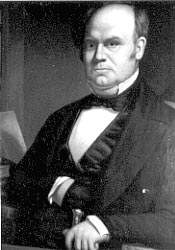 Noah
Martin was born on July 26, 1801 in
Epsom, New Hampshire, son of Samuel
Martin, a shoemaker of probable Scotch-Irish
descent, and Sally (Cochran) Martin.
He had seven brothers and sisters:
Mary, Thomas, James, Elizabeth, Caroline
and Nancy Martin. He married on Oct.
25, 1825, Mary Jane Woodbury, daughter
of Dr. Robert Woodbury of Barrington,
NH, and had two daughters, Elizabeth
A. and Caroline M. Martin. Noah Martin
attended Epsom District schools and
had private tutoring from the Rev.
Jonathan Curtis before attending Permbroke
Academy. He apprenticed under physicians
in Pembroke and Deerfield, New Hampshire
for threre years before attending
the Dartmouth College medical school,
from which he gratudated in the class
of 1824. He practiced medicine in
Pembroke (1824-1825), Great Falls
(1825-1834) and in Dover from 1834,
where he later was founder and first
president of the Dover Medical Association
in 1849. He was a member of the Strafford
District Medical Society from 1835-1863;
its president 1841-1842, and in 1836
was elected a fellow of the New Hampshire
Medical society and was its president
in 1858. Among other duties he was
a member of the American Medical Association,
president of the Strafford County
Savings Bank (1844-1852), Director
of the Dover Bank(1847-1855) and Director
of the Strafford Bank (1860-1863).
His service also included being elected
a member of the New England Historic
Genealogical Society in 1853, and
became its vice president in 1855;
a member of the New Hampshire Historical
Society in 1855; and was a trustee
of the New Hampshire Reform School
from 1855 to1863. Further, his strong
interest in agriculture saw him as
an incorporator of the New Hampshire
Agricultural Society and was its vice
president from 1849 to 1851. Noah
Martin was born on July 26, 1801 in
Epsom, New Hampshire, son of Samuel
Martin, a shoemaker of probable Scotch-Irish
descent, and Sally (Cochran) Martin.
He had seven brothers and sisters:
Mary, Thomas, James, Elizabeth, Caroline
and Nancy Martin. He married on Oct.
25, 1825, Mary Jane Woodbury, daughter
of Dr. Robert Woodbury of Barrington,
NH, and had two daughters, Elizabeth
A. and Caroline M. Martin. Noah Martin
attended Epsom District schools and
had private tutoring from the Rev.
Jonathan Curtis before attending Permbroke
Academy. He apprenticed under physicians
in Pembroke and Deerfield, New Hampshire
for threre years before attending
the Dartmouth College medical school,
from which he gratudated in the class
of 1824. He practiced medicine in
Pembroke (1824-1825), Great Falls
(1825-1834) and in Dover from 1834,
where he later was founder and first
president of the Dover Medical Association
in 1849. He was a member of the Strafford
District Medical Society from 1835-1863;
its president 1841-1842, and in 1836
was elected a fellow of the New Hampshire
Medical society and was its president
in 1858. Among other duties he was
a member of the American Medical Association,
president of the Strafford County
Savings Bank (1844-1852), Director
of the Dover Bank(1847-1855) and Director
of the Strafford Bank (1860-1863).
His service also included being elected
a member of the New England Historic
Genealogical Society in 1853, and
became its vice president in 1855;
a member of the New Hampshire Historical
Society in 1855; and was a trustee
of the New Hampshire Reform School
from 1855 to1863. Further, his strong
interest in agriculture saw him as
an incorporator of the New Hampshire
Agricultural Society and was its vice
president from 1849 to 1851.
Politically,
he was a Jacksonian Democrat, and
as such was elected to the New Hampshire
House of Representatives in 1830,
1832 and 1837. During the years 1835
and 1836 he was a member of the state
Senate. As a Democrat he was elected
Governor of the State of New Hampshire
in 1852 defeating John Atwood of the
Free Soil party (30,800 votes to 9,497),
and Thomas E. Sawyer, a Whig (19,
857 votes). He was re-elected in 1853
(30,934 votes) defeating John F. White
of the Free Soil party (7,995 votes)
and James Bell, the Whig candidate
(17, 590 votes).
As
Governor, Noah Martin proposed a state
Agricultural Commission and urged
that agriculture came under the responsibility
of state educational institutions
and cautioned the legislature against
chartering competitive railroad lines
where there was enough business to
support only one, urging them to make
railroads penally responsible for
loss of life or injury through carelessness.
He was an advocate for private rather
than state ownership of public utilities
and natural resources.
He
was Governor of New Hampshire at the
same time as New Hampshire's native
son Franklin Pierce was President,
and the Governor advocated the enforcement
of the national fugitive slave law
(made legal by the Supreme Court,
1857, Dred Scott decision).
During the time of his governorship
the state continued with economic
expansion and prosperity. Following
his two years as Governor, Noah Martin
returned to Dover and his medical
practice where he died May 28, 1863.
He was a member of the Masonic Fraternity
and the Order of Odd-Fellows.
Information
from the 20th Century Biographical
Dictionary of Notable Americans; an
aritcle by Frank C. Meyers, NHHS;
and the "History of Belknap and
Merrimack Counties by Hurd."
Portrait
copied by A. Tenney from original
by N.B. Onthank. Presented by his
widow (1873).
Location:
State House, Second Floor, Corridor,
West Face, Beginning at Room 208
Article
from Hurd's HISTORY OF MERRIMACK &
BELKNAP COUNTIES
The
active and energetic family of Martin
has impressed itself on many nationalities,
and those bearing that name have attained
eminence in various fields of honor
and usefulness. The American family
goes back through Scotch-Irish stock
to the time when France and Scotland
were so intimately connected, and,
perhaps, to the time when William,
the Conqueror, marshaled his adherents
and retainers for the bloody battle
of Sanguelac or Hastings, which decided
the fate of England and changed the
course of civilization, for on the
list of those who accompanied him
were several of the name. In France
it has been an illustrious name in
law, science and literature. Five
of the Popes have borne the name.
Everywhere we find among the members
of the Martin family ambitious hard-working,
successful, men of more than ordinary
ability.
Early in the eighteenth century, when
the stalwart and freedom-loving defenders
of Londonderry, Ireland, emigrated
to America to found a new Londonderry
in a land where religious persecution
should not seek their blood, Nathaniel
Martin, the earnest man, with Margaret
Mitchell, his wife, and son William,
were among the early settlers who
made a home in this wild and strange
country. Nowhere in America have been
found more honest virtues or more
sterling qualities than were in this
notable settlement, and the descendants
of these people may well look with
pride upon their Scotch-Irish ancestry.
William (2) was born in 1712; married
Hannah Cochrane. Their children were
Mary, James, Nathaniel, William, Robert,
Samuel and Hannah.
Samuel (3), born May 26, 1762; married
Sally, eldest daughter of Major James
Cochrane, of Pembroke, N.H., and had
Polly, Thomas, James, Noah and Nancy.
Noah (4), born in Epsom, N.H., July
26, 1801; married, October 25, 1825,
Mary Jane, daughter of Dr. Robert
Woodbury, of Barrington, and had two
daughters,-Elizabeth A. and Caroline
M. He died May 28, 1863, of apoplexy.
Mrs. Martin died June 30, 1880.
Noah Martin, M.D., was studious from
early life, and, his tastes leading
him in that direction, he elected
to follow the study of medicine, and
persevered through many difficulties
until he had acquired a thorough classical
and professional education. After
the usual attendance at the district
schools and private tuition of Rev.
Jonathan Curtis, he became a pupil
at Pembroke Academy, where he had
the benefit of instruction from those
able preceptors, the Rev. Amos Burnham
and Professor John Vose. His professional
studies were commenced in the office
of Dr. Pillsbury, of Pembroke, with
whom he remained one year, and he
finished his preparatory medical education
with Dr. Graves, of Deerfield, being
with him two years. He then entered
the Medical Department at Dartmouth
College, and was graduated in the
class of 1824, and soon after was
associated with Dr. Graves and in
practice in Deerfield one year. In
1825, Dr. Martin removed to Great
Falls, and, being a thorough student,
he felt that to keep abreast of his
profession he must have a catholicity
of thought that would allow him to
discriminate and use those discoveries
in medical science whichcould be made
beneficial to his fellow men. and
he soon showed that skill and enegery
which is the key-note of success,
acquired a large and lucrative practice,
and was a leading member of the medical
fraternity. After nine years residence
in great falls he removed to Dover.
His established reputation both as
a physician and surgeon, brought him
at once into the confidence of the
people of Dover. And now, after ten
years of professional life, Dr. Martin
was considered one of the best physicians
and surgeons in the State; in fact,
the leading physician in that section,
and the consulting physician in cases
requiring superior medical skill.
His natural dignity of men men and
courteous bearing, united with his
social qualities, pleasing address
and sympathetic heart, made him very
popular. Generous in the matter of
his services, prompt to answer the
call of those from whom no renumeration
could come as well as that of the
weathliest man, all who sought his
counsel found him faithful and sure,
always ready with kind words of advice
and encouragement, and in the many
delicate offices connected with his
profession he displayed that discrimination
sense, judgement and tact, conjoined
with a nice observance of a tender
and scrupulous confidence, which were
among this characteristics, and endeared
him to the hearts of his patients.
He was deeply devoted to his profession,
pursuing it with ceaseless ardor,
giving it his greatest thought and
study, making many sacrifices of a
personal nature for its benefit, keeping
thoroughly informed regarding all
matters pertaining to it and calling
to his aid its most advanced thought.
His career was an eminiently successful
one and he demonstrated what determination,
perseverance, untiring application
and love for his noble art could do,
and filled an honorable and high position.
In
politics Dr. Martin was Democratic,
of that honest and stable Jacksonian
type which holds the object of the
nation to the paramount good of the
people. With but little ambtition
for political preferment, he was not
always able to resist the importunities
of political and personal friends,
and was often brought forward for
political office. He was elected to
the New Hampshire House of Representatives
in 1830, 1832 and 1837, to the New
Hampshire Senate in 1835 and 1836;
and in 1852 and 1853 he was elected
to the highest office of the State,
that of Governor.
Dr.
Martin was elected a member of the
Strafford District Medical Society
in 1835, and was chosen its president
in 1841 and 1842; a member of the
State Medical Society in 1836, and
its President in 1858; and a member
of the American Medical Association
in 1849. He was one of the founders
of the Dover Medical Association,
and its first president in 1849, and
re-elected in 1850. He was elected
a member of the New Hampshire Historical
Society in 1853, also New England
Historical Genealogical Society the
same year; and vice president of the
same, for New Hampshire in 1855. He
was one of the organizers of the Dover
Library, and its president in 1851,
1852 and 1853. He was a member of
the board of trustees of the New Hampshire
Asylum for the Insane in 1852, and
1853, and member of the board of trustees
of rhe House of Reformation for Juvenile
and Female offenders in 1855. He was
one of the incorporators of the State
Agricultural Society, and was elected
vice-president of the same in 1851.
He was chosen president of the Savings-Bank
for the County of Strafford in 1844,
holding the office until 1852, when
he declined a re-election; was a leading
director of the Dover Bank from 1847
to 1855 when he resigned; also a director
of the Strafford Band from 1860 to
the time of his death. He also held
various other offices of trust. He
was a member of the Masonic Fraternity
and of the Order of Odd-Fellows.
In
all the various relations of life,
the kindliness of heart of Dr. Martin,
his gentlemanly and unostentatious
manner and his pre-eminent abilities
won him warm friends and admirers.
Never was a man more conscientious
in the discharge of official duties
or private trusts, and never could
the evil-minded find aught against
his integrity or the purity of his
motives.
|
|
 View all biographies as a pdf file