PAINTINGS


Louis Prang'S Civil War Chromo-Lithographs
 

Louis Prang
(1824-1909)

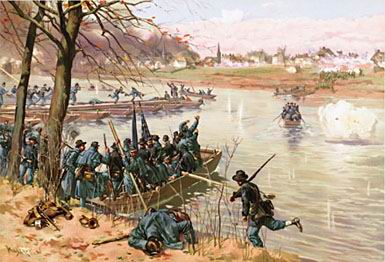
Before dawn on December 11, Union soldiers and engineers began to launch and fasten together pontoon boats to bridge the Rappahannock River. The Confederate sharpshooters waited until it was light, and when the fog lifted, they opened fire on the men building the tandem pontoon bridges. Burnside ordered a brigade to cross the river in loose pontoon boats to roust the snipers. By evening, the Union soldiers had cleared the town. Burnside moved his army across the bridges on December 12, and on the 13th, attacked Lee's well defended positions on Marye's Heights. Burnside's attack was turned back with 12,600 casualties. Lee's repulse of the Union army at Fredericksburg redeemed his failure at Antietam.
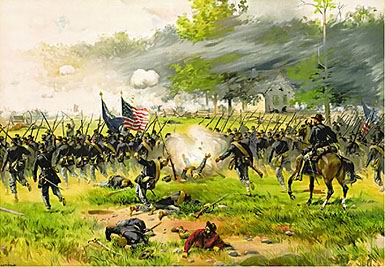
President Lincoln sent General McClellan in pursuit of the Confederate invaders, converging with General Robert E. Lee at Sharpsburg, Maryland. From sunrise until dusk on September 17, 1862, the Union army made repeated assaults on the Confederate lines around Dunker Church, Sunken Road, and around Burnside's Bridge. If McClellan had thrown his entire army against all of Lee's positions at once, the larger Union army would have overwhelmed the Confederates. By nightfall, Lee's battered army still held its positions. McClellan had lost 12,410 men while the Confederates lost 10,318 men killed, wounded or missing. September 17, 1862 became the single "Bloodiest Day" of the Civil War. The devastating losses ended Lee's invasion of the North and his army retreated to Virginia.

General Grant ordered Union troops to attack Confederate defenses at several points simultaneously on May 22 , 1863. In this scene, troops move forward in a hail of gunfire at the Railroad Redoubt. A Union soldier climbs up the Confederate breastworks to plant his regimental colors, but all the Union assaults were driven back. The Union army attacks on both days were unsuccessful, suffering their heaviest losses of the Vicksburg campaign.

The climax of the Battle of Gettysburg came on the afternoon of July 3rd, 1863. Confederate Lt. Gen James Longstreet ordered three divisions, including General George Pickett's division of 5,500 men, to charge across an open field against the center of the Union line. The other two divisions were commanded by Brig. Gen. James Pettigrew and Maj. Gen Isaac Trimble. The Confederates broke through the Union line along a stone wall, known as "the angle" before they were driven back with heavy casualties. "Pickett's Charge" had failed and the battle ended. Lee and his Confederate army retreated to Virginia. This artist's depiction of "Pickett's Charge" is looking southwest from Cemetery Ridge. It shows Union General Winfield Scott Hancock directing the defense of the Confederate charge.

Confederate artillery on the heights of Kennesaw Mountain rains shells down on General Logan's Union troops as they mass for their assault on the morning of June 27, 1864. Sherman's plan called for a diversionary move against Kennesaw Mountain on the Confederate left. The main assault was to be made at the Confederate center, along the Burnt Hickory Road, and south of the Dallas Road, now called Cheatham Hill. Both attacks were brief bloody failures.

Battle of Allatoona Pass


*These prints are available for purchase from http://www.civilwarprints.com/ and these copies are from their web site.


.